Marine Otter
|
|
Advertisement

|
Creature Profile
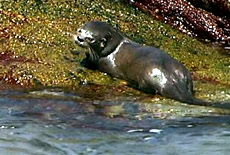
Also called the sea cat, the marine otter is found along the Pacific coastline from equatorial Peru to the southern tip of South America. It has a long body, a flat head with small ears, and a broad muzzle with whiskers. It has coarse, dense dark brown hair and lighter brown underparts. Its feet are equipped with webs for swimming. Adults can reach an average body length of 22 to 31 inches with a tail length of 12 to 14 inches. They can weigh up to 31 lb.
The marine otter prefers habitat with rocky coastal areas and bays and inlets near estuaries. It prefers to eat crustaceans and mollusks and occasionally fish and aquatic vegetation. The marine otter seems to prefer solitary living but has sometimes been seen in groups of three or more. Mating occurs in December until January. The female gives birth to two to five pups after a gestation period of 60 to 120 days.
The main cause of decline is hunting for its fur and loss of suitable habitat. Populations are small and isolated and the estimated but unconfirmed population is said to be 1000 individuals.
Wikipedia Article

|
Wikipedia Article Copyright Notice: This article is licensed under the GNU Free Documentation License. It uses material from the Wikipedia article "Marine otter". |
May 9, 2017
Glenn, C. R. 2006. "Earth's Endangered Creatures - Marine Otter Facts" (Online). Accessed 7/26/2024 at http://earthsendangered.com/profile.asp?sp=313&ID=11.
Need more Marine Otter facts?