Amargosa Vole
|
|
Advertisement

|
Creature Profile
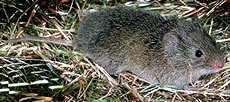
The Amargosa vole is a subspecies of the California vole and is found in the Amargosa River drainage in the Mojave Desert. For many years, this species was thought to be extinct until rediscovered in the 1970s in marshes along the river near Tecopa and Tecopa Hot Springs of Inyo County. Voles are stout, mouse-like rodents with short tails. The Amargosa vole's fur is gray to brown with smoky gray underparts. The ears are barely visible, and the legs are short. Adults reach about eight inches on average, and their tails grow to 2.5 inches on average. The average weight is about 1.9 ounces.
Amargosa voles prefer bulrush marshes for their habitat, and open water must be nearby. Voles are known to make paths through the grasslands leading to the mouths of their underground burrows. These paths become "runways" which are worn into the grass naturally through daily travel, and they are used to escape predators. California voles are herbivores, and this subspecies probably eats grass and other green plants and their seeds. California voles are also known to eat bird eggs or other protein-rich food that can be found easily. Breeding occurs from September to June, and females probably give birth to one to eight young after 21 days of gestation.
This species is threatened by habitat loss due to marsh burning and human disturbance. Also, since it prefers habitat with open water nearby, water drainage and diversion threatens its survival. This disturbance has already caused the extinction of another species in the area, the Tecopa pupfish (Cyprinodon nevadensis calidae), a subspecies of the endangered Nevada pupfish. This species also competes with another rodent, the house mouse (Mus musculus), which is an introduced species. The Amargosa vole is legally protected, and the entire area where it is found is protected and designated as "critical habitat."
Wikipedia Article

|
Wikipedia Article Copyright Notice: This article is licensed under the GNU Free Documentation License. It uses material from the Wikipedia article "Amargosa vole". |
May 10, 2017
Glenn, C. R. 2006. "Earth's Endangered Creatures - Amargosa Vole Facts" (Online). Accessed 4/18/2024 at http://earthsendangered.com/profile.asp?sp=917&ID=9.
Need more Amargosa Vole facts?