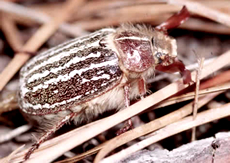
Mt. Hermon June Beetle
R. Arnold |
|
Advertisement

|
Creature Profile
The Mt. Hermon June beetle is a rare June beetle found in the Santa Cruz Mountains south of San Francisco, California. Adults only grow up to about a half an inch long and are covered with white stripes and long, dense brown hair. Females are larger than males. The complete life cycle of this species ranges from only one to four years. As young larvae, these beetles
remain underground feeding on the roots of grass and pine and fruit trees. They do not live long as adults, so their primary purpose as adults is to reproduce. Females do not fly, and it is believed that this may be due their large body sizes. But males are very strong fliers and are often seen flying close to the ground to find potential mates.
Mt. Hermon June beetles are nocturnal and can only be observed at night between 8:45 and 9:30pm. At the end of their flight period, the males burrow back into
the sand, emerging repeatedly on subsequent evenings to continue their search for mates. Mating only occurs in the summer months, hence they are named "June beetles" (although the flight season of males generally extends from mid-June to July). Females lay their eggs in burrows under the ground, and it is believed that they die shortly after. The newly-hatched larvae tunnel from the burrows to feed on plant roots. This may explain their sandy soiled and open habitat preference.
This species is threatened by habitat destruction due to sand mining and urban development. About 60% of its habitat has been loss or disturbed, and much of its remaining habitat is unprotected or privately owned. The US FWS plans to purchase and protect large tracts of sand hill habitat while biologists continuously study the habitat/food requirements and behavior of this species.
Wikipedia Article

|
Wikipedia Article Copyright Notice: This article is licensed under the GNU Free Documentation License. It uses material from the Wikipedia article "Polyphylla barbata". |
May 10, 2017
Glenn, C. R. 2006. "Earth's Endangered Creatures - Mt. Hermon June Beetle Facts" (Online). Accessed 4/18/2024 at http://earthsendangered.com/profile.asp?sp=549&ID=9.
Need more Mt. Hermon June Beetle facts?