West Indian Manatee
|

|
Advertisement

|
Creature Profile
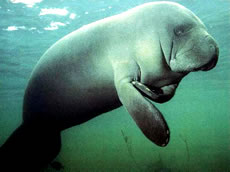
The West Indian manatee is a large, grey-brown, aquatic creature with a seal-like shape. It has a flat paddle shaped tail and there are two small forelimbs on its upper body. Its head and face is
wrinkled and its snout has stiff whiskers. Adults can reach up to 12.5 feet and can weigh up to 3500 lb. Manatees prefer to live in shallow coastal areas such as estuaries, coves and bays where aquatic vegetation is abundant and where the water is relatively undisturbed. They can most often be seen near the mouth of coastal rivers drinking freshwater.
West Indian manatees are herbivorous, spending about 6 to 8 hours a day feeding only on aquatic plants. The rest of the day is spent resting and they prefer to remain under water only surfacing every 2 to 5 minutes to get air. Breeding occurs year-round and females give birth to one calf after a gestation period of 13 months. The calf remains dependent on the mother for up to two years.
There are only about 2500 West Indian manatees left in the wild, and the Florida Manatee (T. m. latirostrus), a subspecies of the West Indian manatee is on the brink of extinction. The cause of decline is mainly from planned or accidental entanglement in gill nets by fishermen. Its habitat is also being destroyed for housing and residential development, agriculture and free zones. Manatees depend on
sea grasses for food, and some coastal areas containing the sea grass have been affected by pollution. A conservation organization was created for the manatee in 1980 called "Operation Sea Cow" to help manage the remaining population of manatees in Jamaica and to possibly hold a small captive population for display for education/awareness and breeding.
Wikipedia Article

|
Wikipedia Article Copyright Notice: This article is licensed under the GNU Free Documentation License. It uses material from the Wikipedia article "West Indian manatee". |
More Links about the West Indian Manatee:
Reference Links:West Indian Manatee - Wikipedia
Conservation Links:
Florida Fish & Wildlife Conservation Commission
May 9, 2017
Glenn, C. R. 2006. "Earth's Endangered Creatures - West Indian Manatee Facts" (Online). Accessed 4/22/2024 at http://earthsendangered.com/profile.asp?sp=701&ID=5.
Need more West Indian Manatee facts?