Bumblebee Bat
|
Creature Profile
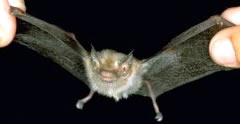
The bumblebee bat (or the Kitti's hog-nosed bat) may be the smallest mammal in the world, reaching only up to 33 mm and weighing only 1.7 to 2 grams, which is about the weight of a dime. It is found in Thailand (a more recent population has been found in Myanmar), and it is the only member of its family (Craseonycteris). This bat has a gray to reddish-brown coloration, its ears are relatively large, and it has a pig-like snout. Its wingspan can grow up to 3 inches.
This species can only be found in limestone caves, and they travel deep inside the caves to remain far from the entrance. They prefer roosting in groups and are active only at dusk, at which time they fly around the tops of bamboo clumps and teak trees. They are insectivorous and feed on insects located on leaves and twigs. They are also known to feed on insects while in flight. Little is known about the reproductive behavior of the species. A female with a single young was observed in May, and a pregnant female was once collected in April.
This species is threatened due to its rarity and because of the decline in its habitat quality. Population estimate is believed to be between 200 and 2000. The status of this species has not been reassessed since the discovery of the Myanmar population, and the Thailand population and its habitat are legally protected.
Wikipedia Article

|
Wikipedia Article Copyright Notice: This article is licensed under the GNU Free Documentation License. It uses material from the Wikipedia article "Kitti's hog-nosed bat". |
May 9, 2017
Glenn, C. R. 2006. "Earth's Endangered Creatures - Bumblebee Bat Facts" (Online). Accessed 4/23/2024 at http://earthsendangered.com/profile.asp?sp=26&ID=3.
Need more Bumblebee Bat facts?