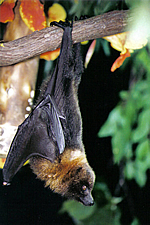
Rodrigues Fruit Bat
© Pam Thomas,Lubee Bat Conservancy |
|
Advertisement

|
Creature Profile
The Rodrigues fruit bat is only found on the island of Rodrigues in the western Indian Ocean. Head and body length of adults is about 35 cm, wingspan is about three feet, and they can weigh up to 250 grams. Their fur is thick and dark brown in color and their heads are covered with golden brown mantles that vary in size and color. The face is similar to that of a fox and its ears are short.
The Rodrigues fruit bat prefers large, contiguous tracts of woodland with mature trees for its habitat. The trees are needed for roosts and protection against the frequent cyclones that occur in the area. They are also a source of food for the bats diet, which consists of leaves, flowers, and fruit. These bats are nocturnal and social, preferring to live in groups of eight to 15 bats. The groups mainly consist of one male and the rest female, but some have been known to allow more than one male in the group. Females produce only one pup after a gestation period of 120 to 180 days.
Rodrigues fruit bats were once abundant in the wild, but their numbers were decreased significantly between 1968 and 1972 during cyclones, which were considered natural climatic disasters. A number of bats were thrown into the sea and some of the surviving bats did not survive because of lack of food and shelter. Natural recovery of the species has been slow, but future cyclones and loss of habitat due to deforestation still threaten the species.
Wikipedia Article

|
Wikipedia Article Copyright Notice: This article is licensed under the GNU Free Documentation License. It uses material from the Wikipedia article "Rodrigues flying fox". |
Conservation Links:
Lubee Bat Conservancy
May 11, 2017
Glenn, C. R. 2006. "Earth's Endangered Creatures - Rodrigues Fruit Bat Facts" (Online). Accessed 4/15/2024 at http://earthsendangered.com/profile.asp?sp=27&ID=1.
Need more Rodrigues Fruit Bat facts?